Pavilion mark - Eispavillon am See
DE TAKE ME THERE
PAVILION CAFÉ ICE WORLD STORY EXPLORE CONTACT DEUTSCHENGLISH
EISPAVILLON AM SEE · BREGENZFROM 1880 TO TODAYSEVEN STATIONS

Ourstory

The shore the pavilion stands on is made land. Seven stations tell how it became a promenade, how an ice cream parlour opened beside it in 1963, and who has run it ever since.

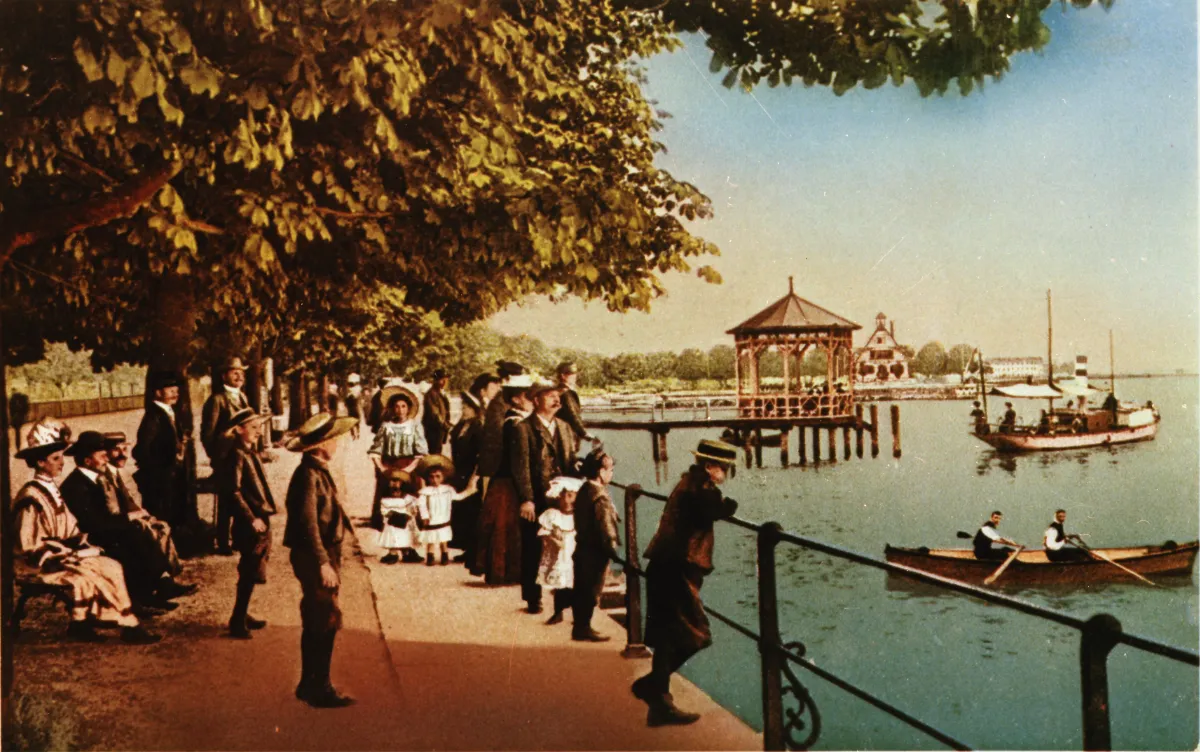
Coloured postcard around 1900: people strolling under the trees on the Bregenz Seepromenade, behind them the fishing pier with its pavilion and rowing boats on the lake
Postcard around 1900, Bregenz city archive
Coloured postcard around 1900: people strolling under the trees on the Bregenz Seepromenade, behind them the fishing pier with its pavilion and rowing boats on the lake
The Bregenz lakeshore before the promenade: stacked timber, boats at the water and a wooden shed
Photo: Bregenz city archive

(01) BEFORE THE PROMENADE

from 1880

A place that did not exist

Where ice cream is served today, timber was stacked at the water. Bregenz built its own shoreline, load by load, over decades.

  • Before the promenade, fishing, the timber trade and shipping shaped the shore: stacked planks, boats at the water, a boathouse behind. The photograph from the Bregenz city archive is undated.
  • In the early 1880s the shore was filled in on a large scale. In 1887 the new promenade passed its first test at the Vorarlberg state exhibition.
  • Today’s Blumenmolo was then called the Westmolo.
  • Between the harbour and the lido this created the green strip where people now walk, cycle and eat ice cream.
The team behind the counter of Café am Molo, above them the sign “cafe am molo · eis-spezialitäten”

(02) THE FOUNDING

1963

The year the lake turned to ice

In February the Bodensee stands still and can be walked across. That same year Frida Fetz opens an ice cream parlour on the promenade, where people are passing anyway.

  • In February 1963 Lake Constance froze over completely for the last time: the Seegfrörne.
  • Three years earlier around 90 per cent of Bregenz had voted against a motorway along the lakeshore. The promenade stayed.
  • Frida Fetz opens her place next to the Molo and calls it Café am Molo.
  • The small coffee counter with its ice cream specialities became the family business that still exists today.
The Bregenz lakeside gardens in 1983: young people sitting on the lawn, behind them the flagpoles of the rondel and the houses of the town centre
Photo: Oskar Spang, Bregenz city archive, CC BY 4.0

(03) THE MOLO YEARS

1970s/80s

The promenade fills up

The shore that never became a motorway fills with lawns, flagpoles and benches. The Café am Molo grows with a town that has just defended its lakefront.

  • Instead of a lakeside road the promenade remained, a decision that still shapes the location today.
  • The lakeside gardens have their ring of flagpoles, flower beds and benches. Oskar Spang’s photograph from spring 1983 shows the lawn in front of the town centre, where the Seestraße runs today.
  • At the Molo there is coffee, ice cream specialities and a few tables on the pavement.
The pavilion under construction, two workmen at the façade

(04) THE NEW BUILDING

1985

A house with eight sides

After more than two decades at the Molo the business gets a building of its own for the first time: octagonal, with a canopy all the way round and a view in every direction.

  • After Frida Fetz died, her daughter Astrid Fetz-Klien took over the business as the second generation.
  • She moves it into the newly built pavilion: many-sided, almost round, with retractable awnings.
  • In 1990 the Gulaschbrücke is taken down, for over a hundred years the link from the station to the lake.
  • The octagonal floor plan has been the emblem of the house ever since.
Inside the pavilion: display case, counter and team

(05) THE LEASE YEARS

1995–97

Other hands

For a few summers tenants run the pavilion. The business carries on, the handwriting changes, then it returns to the family.

  • The pavilion is leased out and run with 20 staff.
  • In the meantime the family keeps learning, gaining experience in other businesses and restaurants.
  • Afterwards the Fussenegger family takes over the Eispavillon.
The pavilion with a full terrace and red parasols

(06) THE SHORE IS REBUILT

2009/10

Everything changes, the pavilion stays

The harbour and the lakeside gardens are rebuilt. The pavilion stands where it stands and gets a new neighbourhood.

  • Harbour and lakeside gardens are completely redesigned: a new harbour building, the Sunset steps at the Blumenmolo, a new lighthouse.
  • Since 2014 the Pipeline has run along the shore as a walkway.
  • The pavilion now sits between the new harbour, the Blumenmolo and the festival grounds.
The pavilion today: glass front, garden terrace and the octagonal upper storey

(07) THIRD GENERATION

Today

The same spot, sixty summers on

The Ice World at the front for takeaway, table service in the garden, the lake in between. The shore has been rebuilt several times; the spot has stayed the same.

  • Today the Fussenegger family runs the business in the third generation.
  • Season from early March to the end of October.
  • The garden opens towards the water, with the same view as in 1963 and a different shore.
PLACE
Lakeshore with timber yard
AT WORK
Fishing, timber trade, shipping
Guests in the garden terrace on the promenade, the lake behind

SINCE 1963

The story continues, every summer on the same shore.